DOI:http://doi.org/10.65613/741899
Dr. Sophia Bertha
Chinese Department, Suqian College, Suqian223800, Jiangsu,China
e-mail: nianbiandong @163.com
Abstract:Chinese classical poetry, as the core carrier of traditional Chinese culture, bears the dual functions of language inheritance and cultural education in basic Chinese education. In the era of digital education transformation, teachers’ comprehensive literacy integrating digital technology and cultural cognition has become a key variable affecting the quality of classical poetry teaching. Based on the improved Culture-DPACK theoretical framework, this study constructs a multi-dimensional influence mechanism model of teachers’ digital-cultural literacy on Chinese classical poetry teaching effect. Through questionnaire survey and path analysis of 426 Chinese teachers in primary and secondary schools, this study systematically explores the direct path, indirect path and regulatory boundary of digital-cultural literacy acting on poetry teaching effect. The research results show that teachers’ five-dimensional literacy of Culture-DPACK (intrinsic knowledge literacy, traditional pedagogical literacy, digital literacy, digital humanities pedagogical literacy, general cultural literacy) all have significant positive predictive effects on classical poetry teaching effect. Among them, digital humanities pedagogical literacy has the strongest direct influence, and general cultural literacy plays a core mediating role in transforming technical ability into teaching quality. Classroom cultural immersion and digital teaching adaptation present significant dual regulatory effects. This study clarifies the internal logical relationship between teachers’ literacy structure and poetry teaching practice, expands the application boundary of the Culture-DPACK framework in traditional cultural teaching, and provides empirical support and optimization paths for the digital and high-quality development of Chinese classical poetry teaching.
Keywords: Digital-Cultural Literacy; Chinese Classical Poetry; Teaching Effect; Culture-DPACK Framework; Path Analysis
1.1 Background of Teaching Reform: Digital Empowerment for Traditional Poetry Inheritance
Chinese classical poetry is a treasure of traditional Chinese culture, condensing the aesthetic connotation, humanistic spirit and historical heritage of the Chinese nation. It occupies an irreplaceable core position in Chinese curriculum teaching and cultural inheritance education. In the context of the new curriculum reform, basic education has clearly put forward the educational goal of “cultivating students’ cultural confidence and humanistic literacy”, and higher requirements have been placed on the depth and effectiveness of classical poetry teaching. Traditional classical poetry teaching mostly adopts the teaching mode of text interpretation, sentence translation and mechanical memorization, which is limited by single teaching method and shallow cultural excavation[1-3]. It is difficult to activate students’ perceptual experience of poetic aesthetics and cultural connotation, resulting in the disconnection between poetry teaching and cultural inheritance, and the dilemma of “memorization without comprehension, learning without appreciation” in teaching practice.
With the comprehensive penetration of digital education technologies such as big data, virtual simulation and intelligent classroom, digital transformation has become an inevitable trend of basic Chinese education. Digital technologies break the time and space limitations of traditional classroom teaching, and provide diversified presentation forms and interactive paths for the display of poetic artistic conception, interpretation of cultural connotation and inheritance of classical aesthetics. However, the empowerment effect of digital technology on poetry teaching is not automatic. The teaching effect depends entirely on teachers’ comprehensive ability to integrate digital technology, cultural cognition and pedagogical skills. Teachers’ digital-cultural literacy, as a compound literacy integrating technical operation, cultural understanding and teaching design, has become the core key to determine whether digital technology can effectively empower classical poetry teaching and realize the deep integration of technical tools and cultural education[4].
1.2 Research Gaps: Deficiencies in Literacy Mechanism and Framework Application
Existing studies on classical poetry teaching mainly focus on three dimensions: teaching method innovation, classroom teaching design and student learning effect optimization. Most studies explore the application effect of single digital technology in poetry teaching, or discuss the teaching strategies of cultural infiltration in poetry classroom. In terms of teacher literacy research, domestic and foreign scholars mostly focus on the independent research of digital teaching literacy or traditional cultural literacy, and there is a lack of systematic research on the compound digital-cultural literacy adapted to traditional cultural teaching. In particular, the internal influence mechanism of teachers’ multi-dimensional literacy on poetry teaching effect is still unclear, and there is a lack of empirical path verification based on mature theoretical frameworks.
The Culture-DPACK framework, as an improved theoretical system based on the traditional TPACK model for Chinese language teaching scenarios, constructs a multi-dimensional literacy structure integrating knowledge, pedagogy, digital technology and cultural cognition, which is highly compatible with the research theme of this study. However, the current application of the Culture-DPACK framework is mostly limited to the scale development and literacy evaluation of Chinese teachers, and there is no in-depth discussion on its internal mechanism acting on specific curriculum teaching effects. In view of this, this study takes the Culture-DPACK framework as the core theoretical support, constructs an influence mechanism model of digital-cultural literacy on classical poetry teaching effect, and verifies the action path and influence intensity of each dimension through empirical analysis, so as to make up for the research gaps in the field of poetry teaching literacy research.
1.3 Research Significance: Theoretical Innovation and Practical Value
In terms of theoretical significance, this study expands the application scope of the Culture-DPACK framework from teacher literacy evaluation to curriculum teaching mechanism research, clarifies the multi-dimensional structure of teachers’ digital-cultural literacy in classical poetry teaching scenarios, and reveals the direct, indirect and regulatory paths of each literacy dimension affecting teaching effect. It constructs a systematic theoretical system of “literacy structure-behavior practice-teaching effect” for traditional cultural curriculum teaching, which enriches the theoretical research achievements of digital education and traditional cultural teaching.
In terms of practical value, this study verifies the key literacy dimensions and core action paths that affect the quality of classical poetry teaching, provides targeted optimization strategies for teachers’ digital-cultural literacy improvement and poetry digital teaching reform, and helps to solve the practical dilemmas of superficial digital application and insufficient cultural infiltration in current poetry teaching[5]. It provides empirical basis and practical reference for educational administrative departments to formulate teacher training plans and promote the high-quality development of traditional cultural education.
1.4 Research Framework and Technical Route
This study follows the research logic of “theoretical construction-hypothesis proposal-empirical verification-conclusion optimization”. Firstly, it sorts out the connotation of Culture-DPACK framework and the correlation between digital-cultural literacy and poetry teaching effect through literature research. Secondly, it constructs the influence mechanism model and puts forward research hypotheses. Thirdly, it designs questionnaires to collect sample data, and uses structural equation model and path analysis to test the hypothesis. Finally, it summarizes the research conclusions, analyzes the existing deficiencies and puts forward teaching optimization strategies. The whole research strictly adheres to the combination of theoretical research and empirical analysis, ensuring the scientificity and pertinence of the research conclusions.
2. Theoretical Foundation and Literature Review
2.1 Connotation Interpretation: Multi-Dimensional Structure of Culture-DPACK Framework
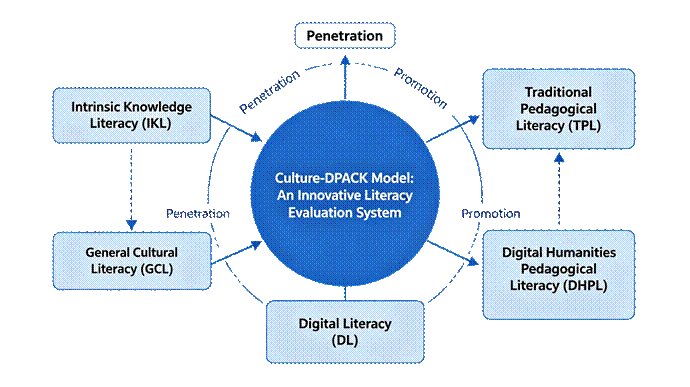
The Culture-DPACK framework is an innovative literacy evaluation system derived from the traditional Technological Pedagogical Content Knowledge (TPACK) framework, which is specially optimized for the teaching characteristics of Chinese language and traditional cultural courses. Different from the single technical-pedagogical knowledge structure of the traditional TPACK model, the Culture-DPACK framework integrates cultural literacy elements closely combined with Chinese traditional culture teaching, and constructs five interrelated and interactive core literacy dimensions, covering intrinsic knowledge literacy, traditional pedagogical literacy, digital literacy, digital humanities pedagogical literacy and general cultural literacy. The five dimensions penetrate and promote each other, forming a complete compound literacy system for Chinese teachers’ traditional cultural teaching[6-8].
Intrinsic Knowledge Literacy (IKL) is the basic literacy of teachers’ professional teaching, which refers to teachers’ systematic mastery of Chinese classical poetry’s text content, artistic conception connotation, historical background, ideological value and aesthetic characteristics. It is the premise of carrying out high-quality poetry teaching and cultural inheritance. Traditional Pedagogical Literacy (TPL) focuses on teachers’ traditional classroom teaching ability, including curriculum design, classroom explanation, student guidance and teaching evaluation ability adapted to classical poetry teaching rules. Digital Literacy (DL) refers to teachers’ basic ability of digital technology operation, digital resource development and digital teaching tool application, which is the technical foundation of digital poetry teaching.
Digital Humanities Pedagogical Literacy (DHPL) is the core compound literacy of the framework, which integrates digital technology, humanistic spirit and pedagogical knowledge. It emphasizes teachers’ ability to use digital means to excavate poetic cultural connotation, present artistic aesthetic and carry out humanistic education. General Cultural Literacy (GCL) is the extended literacy of teachers’ cultural cognition, covering the accumulation of traditional Chinese culture, cultural interpretation ability and cultural inheritance awareness, which determines the depth and temperature of poetry cultural teaching. The five-dimensional structure of Culture-DPACK covers the whole process of poetry teaching from professional foundation, technical support, teaching implementation to cultural infiltration, which fully adapts to the dual teaching goals of knowledge teaching and cultural inheritance of classical poetry courses.
2.2 Literature Review: Correlation Between Digital-Cultural Literacy and Poetry Teaching
In the research of digital literacy and poetry teaching, foreign scholars have long focused on the integration of digital technology and traditional literary teaching. Relevant studies have shown that digital visualization technology, virtual scene simulation and interactive digital resources can effectively activate students’ literary perception and aesthetic experience, and improve students’ learning initiative and teaching participation in classical literary courses. Domestic studies have further confirmed that teachers’ digital teaching ability directly affects the application depth of digital resources in poetry classrooms[9]. Teachers with high digital literacy can break the limitations of traditional teaching, build diversified poetic teaching scenes, and realize the transformation from knowledge indoctrination to aesthetic education and cultural inheritance.
In the research of cultural literacy and poetry teaching, scholars generally believe that teachers’ traditional cultural accumulation is the core of classical poetry teaching. Excellent general cultural literacy can help teachers accurately grasp the cultural origin, ideological connotation and aesthetic value of poetry works, and realize the in-depth interpretation of poetry texts and the effective infiltration of cultural spirit. Teachers with insufficient cultural literacy often stay in the shallow teaching of poetry vocabulary and syntax, which is difficult to realize the educational value of poetry aesthetic education and cultural inheritance.
In the compound literacy research of digital culture, existing studies have pointed out that the single digital technology ability or cultural literacy cannot fully adapt to the digital transformation of traditional cultural teaching. Only the compound literacy that integrates digital technology and cultural cognition can effectively empower traditional poetry teaching. However, most existing studies stay in theoretical discussion and qualitative analysis, lacking quantitative empirical research on the influence mechanism and path effect of compound digital-cultural literacy on poetry teaching effect, which also provides the research space for this study[10].
2.3 Theoretical Logic: Internal Action Mechanism of Framework Dimensions
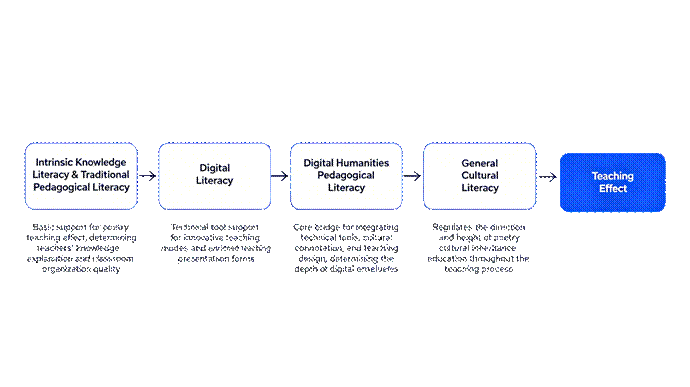
Based on the connotation of Culture-DPACK framework and the teaching characteristics of Chinese classical poetry, this study sorts out the internal action logic of each literacy dimension on teaching effect. Firstly, intrinsic knowledge literacy and traditional pedagogical literacy constitute the basic support of poetry teaching effect, which determines the basic quality of teachers’ poetry knowledge explanation and classroom teaching organization. Secondly, digital literacy provides technical tool support for innovative poetry teaching mode and enriching teaching presentation forms. Thirdly, digital humanities pedagogical literacy acts as the core bridge, realizing the organic integration of technical tools, cultural connotation and teaching design, and determining the depth of digital empowerment of poetry cultural teaching. Finally, general cultural literacy runs through the whole teaching process, regulating the direction and height of poetry cultural inheritance education.
3. Research Hypotheses and Model Construction
3.1 Research Hypotheses Proposal
Based on the theoretical analysis of Culture-DPACK framework and existing research conclusions, this study puts forward direct effect hypotheses, mediating effect hypotheses and moderating effect hypotheses layer by layer, focusing on the multi-path influence of teachers’ digital-cultural literacy on classical poetry teaching effect.
3.1.1 Direct Effect Hypotheses
H1: Each dimension of teachers’ Culture-DPACK literacy has a significant positive direct effect on Chinese classical poetry teaching effect. H1a: Intrinsic knowledge literacy positively affects poetry teaching effect; H1b: Traditional pedagogical literacy positively affects poetry teaching effect; H1c: Digital literacy positively affects poetry teaching effect; H1d: Digital humanities pedagogical literacy positively affects poetry teaching effect; H1e: General cultural literacy positively affects poetry teaching effect.
3.1.2 Mediating Effect Hypotheses
H2: General cultural literacy plays a significant mediating role between the other four dimensions of Culture-DPACK literacy and poetry teaching effect. Teachers’ professional knowledge, pedagogical ability and digital technology ability can further improve poetry teaching effect by improving cultural cognition and cultural interpretation level.
3.1.3 Moderating Effect Hypotheses
H3: Classroom cultural immersion and digital teaching adaptation play significant positive moderating roles in the influence path of digital-cultural literacy on poetry teaching effect. Higher classroom cultural immersion and digital teaching adaptation can strengthen the positive influence of teachers’ compound literacy on teaching effect.
3.2 Research Model Construction
This study takes the five dimensions of Culture-DPACK framework as independent variables, classical poetry teaching effect as dependent variable, general cultural literacy as mediating variable, and classroom cultural immersion and digital teaching adaptation as moderating variables. A multi-path influence mechanism model of teachers’ digital-cultural literacy on Chinese classical poetry teaching effect is constructed. The model covers direct influence path, indirect mediating path and situational regulating path, fully presenting the multi-dimensional and multi-level action logic of teachers’ literacy on poetry teaching practice.
4. Research Design and Data Sources
4.1 Questionnaire Design and Variable Measurement
Based on the mature scale of Culture-DPACK framework and the actual situation of classical poetry teaching, this study designs a formal questionnaire with good reliability and validity. The questionnaire is divided into four parts: basic information of respondents, measurement of digital-cultural literacy dimensions, measurement of mediating and moderating variables, and measurement of poetry teaching effect. All measurement items adopt 5-point Likert scoring method, with 1 representing “strongly disagree” and 5 representing “strongly agree”. The variable measurement items are optimized and adjusted according to the teaching scenario of Chinese classical poetry to ensure the pertinence and accuracy of measurement.
The independent variable (digital-cultural literacy) is measured by five dimensions of Culture-DPACK, with 4 items for each dimension, totaling 20 measurement items. The mediating variable (general cultural literacy) adopts the corresponding dimension items of the framework for secondary verification. The moderating variables (classroom cultural immersion, digital teaching adaptation) are set with 4 items respectively[11-13]. The dependent variable (classical poetry teaching effect) is measured from three dimensions: knowledge teaching effect, aesthetic education effect and cultural inheritance effect, with 5 items in total. Before the formal survey, this study conducts a pre-survey of 80 samples, revises and deletes ambiguous and repetitive items, and finally forms a formal questionnaire with 37 valid measurement items.
4.2 Sample Collection and Data Screening
The research samples are primary and secondary school Chinese teachers engaged in front-line classical poetry teaching in multiple regions of China. The survey adopts online questionnaire random sampling method, and the survey time is from March to April 2026. A total of 452 questionnaires are distributed, and 426 valid questionnaires are recovered after eliminating invalid questionnaires with regular answers, missing key information and too short filling time, with an effective recovery rate of 94.25%. The sample covers urban and rural schools of different educational stages, ensuring the diversity and representativeness of the research samples.
4.3 Reliability and Validity Test of Questionnaire
This study uses SPSS 26.0 and AMOS 24.0 software to test the reliability and validity of the questionnaire data. The reliability test results show that the Cronbach’s α coefficients of all variables are greater than 0.8, and the composite reliability (CR) values of each dimension are all higher than the standard value of 0.7, indicating that the questionnaire has good internal consistency reliability. The validity test results show that the KMO value of the whole scale is 0.862, and the Bartlett spherical test significance is less than 0.001, which is suitable for factor analysis. The average variance extracted (AVE) values of each dimension are all greater than 0.5, indicating that the scale has good convergent validity. The discriminant validity of each variable is good, and there is no serious common method deviation in the data.
| Variable Dimension | Item Number | Cronbach’s α | CR Value | AVE Value |
| Intrinsic Knowledge Literacy (IKL) | 4 | 0.846 | 0.852 | 0.587 |
| Traditional Pedagogical Literacy (TPL) | 4 | 0.832 | 0.841 | 0.562 |
| Digital Literacy (DL) | 4 | 0.851 | 0.863 | 0.594 |
| Digital Humanities Pedagogical Literacy (DHPL) | 4 | 0.872 | 0.881 | 0.625 |
| General Cultural Literacy (GCL) | 4 | 0.849 | 0.857 | 0.591 |
| Classroom Cultural Immersion (CCI) | 4 | 0.828 | 0.835 | 0.558 |
| Digital Teaching Adaptation (DTA) | 4 | 0.835 | 0.842 | 0.569 |
| Poetry Teaching Effect (PTE) | 5 | 0.868 | 0.875 | 0.612 |
Table 1. Reliability and Validity Test Results of the Scale
5. Empirical Results and Path Analysis
5.1 Descriptive Statistical Analysis of Variables
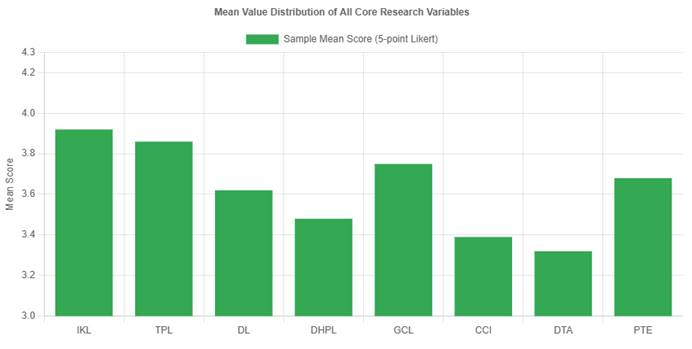
This study conducts descriptive statistical analysis on the mean value, standard deviation, skewness and kurtosis of all core variables, so as to grasp the overall distribution characteristics of sample data. The statistical results show that the mean values of all variables are distributed between 3.26 and 4.18, indicating that the overall level of teachers’ digital-cultural literacy and classical poetry teaching effect is at the medium and upper level. The standard deviation of each variable is between 0.42 and 0.59, indicating that the data fluctuation is small and the sample distribution is relatively uniform. The absolute values of skewness and kurtosis of all variables are within the standard range, which conforms to the normal distribution characteristics, meeting the basic requirements of structural equation model analysis.
| Variable | Mean | Std. Deviation | Skewness | Kurtosis |
| IKL | 3.92 | 0.48 | -0.326 | 0.215 |
| TPL | 3.86 | 0.51 | -0.289 | 0.186 |
| DL | 3.62 | 0.56 | -0.251 | 0.152 |
| DHPL | 3.48 | 0.59 | -0.228 | 0.136 |
| GCL | 3.75 | 0.53 | -0.267 | 0.172 |
| CCI | 3.39 | 0.55 | -0.235 | 0.148 |
| DTA | 3.32 | 0.57 | -0.219 | 0.129 |
| PTE | 3.68 | 0.52 | -0.274 | 0.163 |
Table 2. Descriptive Statistical Results of Core Variables
5.2 Direct Path Effect Analysis
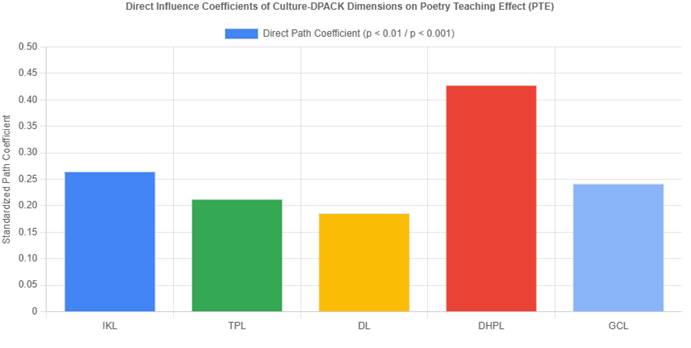
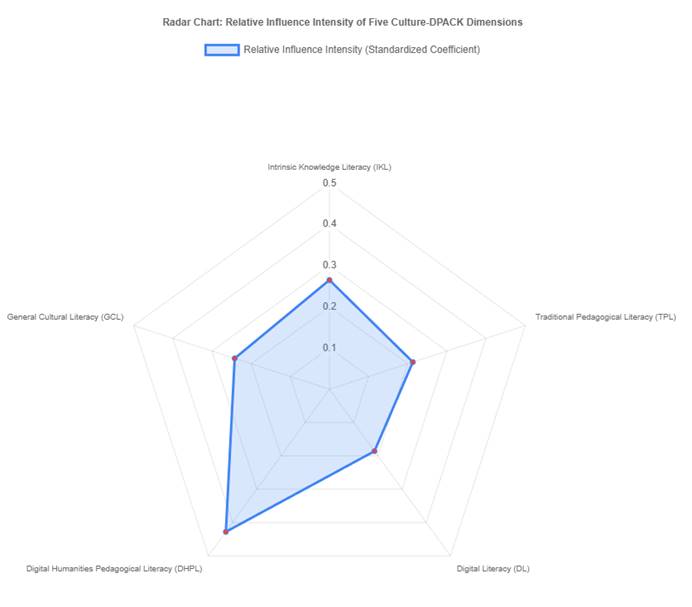
Based on the structural equation model, this study tests the direct influence path of each dimension of Culture-DPACK literacy on classical poetry teaching effect. The path coefficient test results show that all five dimensions of digital-cultural literacy have significant positive direct effects on poetry teaching effect, and the research hypothesis H1 is fully verified. Among them, the direct path coefficient of digital humanities pedagogical literacy (DHPL→PTE=0.428, p<0.001) is the largest, indicating that this compound literacy is the most critical factor affecting poetry teaching effect. It fully shows that the organic integration of digital technology and humanistic pedagogy is the core key to improve the quality of digital poetry teaching.
The direct path coefficient of intrinsic knowledge literacy (IKL→PTE=0.265, p<0.001) ranks second, which verifies that teachers’ solid professional knowledge reserve is the basic guarantee of high-quality poetry teaching. The direct path coefficient of traditional pedagogical literacy (TPL→PTE=0.213, p<0.01) is relatively stable, reflecting that traditional classroom teaching ability still plays an indispensable basic role in poetry teaching. The direct path coefficient of digital literacy (DL→PTE=0.186, p<0.01) is relatively low, indicating that simple digital technology operation ability has limited direct contribution to teaching effect, and technical ability needs to be combined with humanistic pedagogy to exert greater value. The direct path coefficient of general cultural literacy (GCL→PTE=0.242, p<0.001) is prominent, showing that teachers’ cultural cognition level directly determines the depth of poetry cultural teaching.
5.3 Mediating Path Effect Analysis
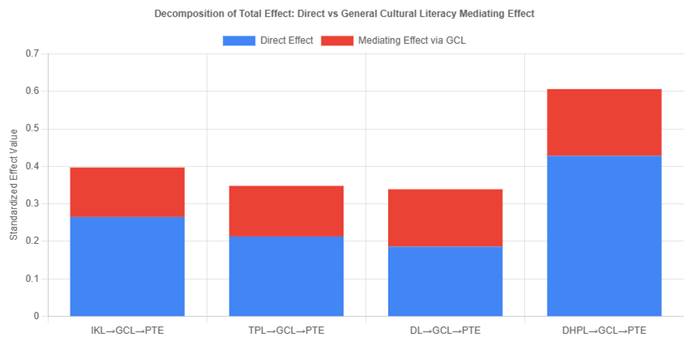
This study adopts the bootstrap mediating effect test method to verify the mediating role of general cultural literacy. The test results show that general cultural literacy has significant partial mediating effects between the other four dimensions of Culture-DPACK literacy and poetry teaching effect, and the research hypothesis H2 is verified. The specific mediating path coefficients are shown in Table 3. Among them, the mediating effect of digital literacy through general cultural literacy is the most significant, with a mediating effect value of 0.153, accounting for 45.2% of the total effect. It indicates that digital technology ability mainly improves poetry teaching effect by enriching teachers’ cultural presentation forms and deepening cultural interpretation dimensions.
The mediating effect proportion of traditional pedagogical literacy is 38.6%, which shows that traditional teaching ability can further release teaching value by combining with cultural cognition. The mediating effect proportion of intrinsic knowledge literacy is 32.8%, indicating that professional knowledge needs to be transformed into cultural teaching ability to better improve teaching effect. The mediating effect proportion of digital humanities pedagogical literacy is 29.4%, which shows that this compound literacy itself has strong direct teaching empowerment ability, and the mediating amplification effect of cultural literacy is relatively weak.
| Mediating Path | Direct Effect | Mediating Effect | Total Effect | Mediating Proportion | p Value |
| IKL→GCL→PTE | 0.265 | 0.132 | 0.397 | 32.8% | <0.001 |
| TPL→GCL→PTE | 0.213 | 0.135 | 0.348 | 38.6% | <0.001 |
| DL→GCL→PTE | 0.186 | 0.153 | 0.339 | 45.2% | <0.001 |
| DHPL→GCL→PTE | 0.428 | 0.178 | 0.606 | 29.4% | <0.001 |
Table 3. Test Results of Mediating Effect of General Cultural Literacy
5.4 Moderating Path Effect Analysis
The hierarchical regression analysis results show that classroom cultural immersion and digital teaching adaptation have significant positive moderating effects on the main influence path, and the research hypothesis H3 is verified. Specifically, classroom cultural immersion significantly strengthens the influence of general cultural literacy and digital humanities pedagogical literacy on teaching effect. In high cultural immersion classrooms, teachers’ cultural interpretation and digital humanistic teaching design can be better perceived and accepted by students, and the teaching empowerment effect of compound literacy is significantly amplified.
Digital teaching adaptation mainly regulates the influence path of digital literacy and digital humanities pedagogical literacy. When teachers and students have high adaptation to digital teaching tools and digital classroom mode, digital technology can be more closely integrated with poetry cultural teaching, effectively avoiding the formalization and superficiality of digital teaching. The dual moderating effect shows that the exertion of teachers’ digital-cultural literacy teaching value is not isolated, but needs to be matched with good classroom cultural atmosphere and digital teaching adaptation environment to form a synergistic empowerment effect.
6. Research Conclusions and Mechanism Discussion
First, teachers’ five-dimensional digital-cultural literacy based on Culture-DPACK framework has significant positive predictive effect on Chinese classical poetry teaching effect. The influence intensity of each dimension is hierarchical, among which digital humanities pedagogical literacy is the core dominant factor, intrinsic knowledge literacy and general cultural literacy are basic key factors, and traditional pedagogical literacy and digital literacy are important supporting factors. This hierarchical influence structure clarifies the core literacy orientation of poetry digital teaching reform.
Second, general cultural literacy plays a significant partial mediating role in the influence mechanism of digital-cultural literacy on poetry teaching effect. Technical literacy and pedagogical literacy cannot directly maximize teaching value, and they need to rely on the transformation and amplification of cultural literacy to realize the deep integration of technology, pedagogy and culture. The mediating effect intensity varies with different independent variables, forming differentiated indirect empowerment paths.
Third, classroom cultural immersion and digital teaching adaptation present significant dual situational moderating effects. The teaching empowerment effect of digital-cultural literacy has obvious situational dependence. Good classroom cultural atmosphere and high digital teaching adaptation can effectively strengthen the positive influence of teachers’ compound literacy on poetry knowledge teaching, aesthetic education and cultural inheritance effect, forming a complete “literacy-situation-effect” three-level influence mechanism.
6.2 In-Depth Discussion of Influence Mechanism
Based on the Culture-DPACK framework, this study clarifies the essential logic of teachers’ digital-cultural literacy affecting classical poetry teaching effect, and constructs a multi-path synergistic influence mechanism of “basic support-core drive-cultural transformation-situational regulation”. First, intrinsic knowledge literacy and traditional pedagogical literacy constitute the basic support mechanism of poetry teaching effect, which undertakes the basic functions of poetry text interpretation and classroom teaching organization, and is the premise of all innovative teaching and cultural inheritance.
Second, digital humanities pedagogical literacy forms the core driving mechanism of teaching effect improvement. Different from single digital technology or single pedagogical ability, this compound literacy breaks the barrier between technical tools and humanistic education, realizes the organic integration of digital scene construction, poetic aesthetic presentation and cultural spirit inheritance, and is the fundamental driving force to solve the dilemma of superficial digital teaching and insufficient cultural infiltration.
Third, general cultural literacy builds the cultural transformation mechanism of literacy empowerment. All technical and pedagogical literatures need to be transformed into cultural teaching power through cultural cognition and interpretation ability, so as to realize the transformation from simple knowledge teaching to in-depth cultural inheritance and aesthetic education, and improve the comprehensive teaching value of classical poetry courses[14].
Fourth, classroom situation factors form the situational regulation mechanism of teaching effect. Classroom cultural immersion optimizes the cultural transmission environment, and digital teaching adaptation reduces the friction cost of technology application. The two situational factors jointly regulate the exertion of teachers’ literacy value, ensuring the stable and efficient play of multi-dimensional literacy empowerment effect.
7. Teaching Optimization Strategies and Practical Suggestions
7.1 Focus on Core Literacy, Optimize Teachers’ Compound Literacy Training System
Based on the core dominant position of digital humanities pedagogical literacy, schools and educational institutions should adjust the existing teacher training system, change the separate training mode of digital technology and cultural knowledge, and carry out special training on digital humanistic teaching design for classical poetry. Focus on cultivating teachers’ ability to use digital tools to excavate poetic cultural connotation, construct poetic artistic conception scenes and design humanistic interactive teaching activities, and improve the core compound literacy of teachers. At the same time, consolidate teachers’ professional knowledge reserve and traditional pedagogical ability, and build a hierarchical and systematic digital-cultural literacy training system.
Teachers should take general cultural literacy as the transformation carrier of technical and pedagogical ability, and avoid the formalization of digital teaching. In classical poetry teaching practice, teachers should take cultural inheritance and aesthetic education as the core goal, select targeted digital resources and teaching tools according to the cultural connotation and artistic characteristics of poetry works, realize the organic integration of digital technology application and poetry cultural interpretation, and transform technical advantages into cultural teaching advantages. Schools should organize regular poetry digital teaching case sharing and teaching research activities to guide teachers to summarize the cultural transformation path of digital teaching[15].
7.3 Optimize Classroom Situation, Build a Cultural Digital Teaching Ecosystem
Schools should actively build a high-quality digital poetry classroom teaching ecosystem. On the one hand, create a strong classroom cultural immersion atmosphere, integrate traditional cultural elements such as poetry calligraphy, ancient scene restoration and traditional music into digital classrooms, and enhance students’ perceptual experience of poetic culture. On the other hand, strengthen teachers and students’ digital teaching adaptation training, optimize the operation difficulty of digital teaching tools, carry out school-based digital teaching practice activities, and improve the matching degree between teachers and students’ digital literacy and digital teaching mode, so as to give full play to the synergistic empowerment effect of situational factors.
7.4 Improve Teaching Evaluation, Establish a Diversified Teaching Quality Evaluation Mechanism
Educational administrative departments and schools should break the single evaluation orientation of poetry teaching based on knowledge mastery, and establish a diversified teaching evaluation system covering knowledge teaching, aesthetic experience and cultural inheritance. Incorporate teachers’ digital-cultural literacy application ability and classroom cultural teaching effect into the teaching evaluation index system, guide teachers to pay attention to the in-depth integration of digital technology and cultural teaching, and promote the high-quality and sustainable development of classical poetry digital teaching.
8. Research Limitations and Future Prospects
This study systematically explores the influence mechanism of teachers’ digital-cultural literacy on classical poetry teaching effect based on Culture-DPACK framework, but there are still some deficiencies. First, the research sample is limited to partial regional primary and secondary school teachers, and the sample coverage can be further expanded to improve the universality of research conclusions. Second, this study only explores the overall influence mechanism at the macro level, and does not discuss the differentiated influence paths of different school stages, teacher age and teaching experience. Third, this study adopts cross-sectional data for empirical analysis, and cannot verify the dynamic change law of literacy influence effect in the long-term teaching process.
On the basis of this study, future research can further expand the sample coverage, carry out comparative research on different regional and stage teaching scenarios, and explore the heterogeneous influence mechanism of digital-cultural literacy. At the same time, longitudinal tracking research can be carried out to dynamically analyze the change characteristics of teachers’ literacy empowerment effect in the long-term teaching practice. In addition, future research can further optimize the Culture-DPACK framework according to the characteristics of classical poetry teaching, explore more situational regulatory variables, and build a more perfect and refined theoretical mechanism system for traditional cultural curriculum digital teaching.
This study takes Chinese primary and secondary school Chinese teachers as the research object, constructs a multi-path influence mechanism model based on the Culture-DPACK framework, and systematically verifies the direct effect, mediating effect and moderating effect of teachers’ digital-cultural literacy on Chinese classical poetry teaching effect through empirical analysis. The research confirms that teachers’ five-dimensional digital-cultural literacy has significant positive influence on poetry teaching effect, digital humanities pedagogical literacy is the core influencing factor, general cultural literacy plays a key mediating transformation role, and classroom situation factors have important regulatory and synergistic effects. The internal influence mechanism of “basic support-core drive-cultural transformation-situational regulation” is clarified.
This research not only enriches the theoretical application of Culture-DPACK framework in traditional cultural teaching, but also provides empirical evidence and practical guidance for solving the practical dilemmas of digitalization and cultural infiltration in classical poetry teaching. In the digital education era, improving teachers’ digital-cultural compound literacy, promoting the deep integration of digital technology and poetry cultural teaching, and optimizing classroom cultural digital teaching situation are the key paths to improve the quality of Chinese classical poetry teaching and realize the inheritance and innovation of traditional Chinese culture.
Reference
[1]Yu Z ,Ren Y ,Zhang T , et al. PoetRAT: A poetry retrieval augmented thoughts framework for Chinese classical poetry generation[J].Applied Soft Computing,2026,196 115135-115135.
[2] Retraction of: “Sentiment analysis of Chinese ancient poetry based on multidimensional knowledge attention”[J].Digital Scholarship in the Humanities,2026,41 (2):1197-1197.
[3]Maciej K . From Character to Poem: Nested Contexts and Scalar Limits of Parallelism Detection in Classical Chinese Poetry[J].Journal of Open Humanities Data,2026,12 34-34.
[4]Ali T ,Sultan H . Translating Classical Chinese Poetry into English: Challenges and Approaches[J].The Educational Review, USA,2026,10 (2).
[5]Zhang L . Re-thinking cultural authenticity in Mulan (1998): through the lens of classical Chinese poetry[J].Adaptation,2026,19 (1).
[6]Zheng J ,Cao M ,Zhang C . AI-driven generation of guzheng music from classical Chinese poetry: toward a new paradigm of creative practice in Chinese traditional Music[J].Multimedia Systems,2025,31 (6):437-437.
[7]Lin Y . Action Research on Enhancing the Classical Chinese Poetry Teaching Skills of Elementary Education Program Students[J].International Journal of Innovation, Management and Technology,2025,16 (3).
[8]Lin Z . Exploration of AI Technology Empowering High School Chinese Ancient Poetry Teaching[J].New Explorations in Education and Teaching,2025,3 (8).
[9]Qin Z ,Ng S ,Song Y . Shades of Grey: Quantifying a Database of 18 Aesthetic Moods in Classical Chinese Poetry[J].Empirical Studies of the Arts,2025,43 (2):1181-1213.
[10]Jiang X . Translating Intertextual Overtones: With Emphasis on English Translation of Classic Chinese Poems[J].Theory and Practice in Language Studies,2025,15 (6):1930-1937.
[11]Lang B ,Numtong K . Meaning Behind Words: Enhancing the Comprehension of Imagery in Classical Chinese Poetry for Teaching Chinese as a Second Language (TCSL)[J].Theory and Practice in Language Studies,2025,15 (3):743-754.
[12]Yawen Z . Analysis of the teaching status and countermeasures of Chinese classical poetry from the perspective of international Chinese education: Taking Su Shi’s poetry as an example[J].SHS Web of Conferences,2025,222 04023-04023.
[13]Cao J . Aesthetic Education through Classical Chinese Poetry in Higher Vocational English Teaching[J].Occupation and Professional Education,2024,1 (4).
[14]Zhang Y . Teaching Classical Chinese Poetry through Reception Studies[J].The ASIANetwork Exchange: A Journal for Asian Studies in the Liberal Arts,2019,26 (1):75-95.
[15]Congying F .To Appreciate the Beauty of Emotions in Classical Chinese Poetry and Prose:Teaching Strategies on Aesthetic Education of Chinese Courses in Vocational Colleges[C]//Atlantis Press,2022.